Okay, I will not give this one up. I will try one more time. I think I have started writing this article four times now. I don’t know why it is particularly difficult for me to get it done, but it has been for several months now. Let’s see, if I am able to succeed this time…
As I told you about in one of my later posts, I hosted a small gathering in the beginning of May. And as mentioned I had unwittingly made some kind of ruling that it would be a “Spice” tournament. There was some discussion in the event page about what would constitute a spicy deck, and comments such as “I don’t want to sit across The Deck with Su-Chis or Clay Statues and have it called spice!” surfaced.
And of course this sparked the good old “But what is spicy, actually? What does it mean to play a spicy deck? What. Is. The. Definition. ?.”
So this is what I am about to discuss a bit here today. It will probably not be as extensive as my discussion on and definition of Combo, as found here (LINKLINKLINK), but let’s see where we end up…
The question(s) in question
See, I actually think the definition of spicy in the realm of Magic is rather spot on. Spicy – in the dictionary sense of the word – is when something is flavored or if it is exciting or entertaining – often even mildly indecent (my most favorite kind of indecent!).
Right. With that out of the way. I mean, I know you are all here for some good old dictionary definitions to really get things heated, but there really is no more soup to cook on this one.
By no means an official definition of course, but basically all definitions, I have been able to find of spicy in regards to Magic the Gathering, was something along the lines of this: “Spicy is when you use unconventional tactics.” Or when you have built a deck with some kind of twist to surprise the opponent. These are basically drawn directly from a Reddit discussion – the place to go, when you are in need of knowledge of the nerding sphere (REDDIT LINK). Anyway, the important word is unconventional or twist.
And now that we are here (and in the aforementioned Reddit discussion): There is some difference between spicy and janky, as a spicy deck would most often still try to go through with a specific somewhat tested plan, whereas a janky one is more or less an untested and probably non-functioning pile of rubbish or those sweet, sweet pet cards and interactions that are either completely useless in reality or just way, way to intricate or mana-intensive.
Anyway, as mentioned, I think the above is an okay definition of what spicy is. And so I could of course end my writings right here and now. But no; no such luck for you. Because what I want to discuss today is how to interpret the definition: what does “unconventional” mean and when is something unconventional enough? When does something stop being unconventional? And does it all only refer specifically to the cards/deck you are playing, or could you do something or act in a way that would also place you in the coveted section of spice?
I will not be able to answer all of these questions in full – and it is not my point here either – I just want to try to put some words on the fact that the word spicy is being thrown around, but I am certain that we do not all agree, what it actually means. I don’t think we will agree even after all of my words on the matter, but maybe it will stir some thoughts or provoke some conversation. In this time and age, thoughts and conversation are pure gold in my book.
In the beginning there was…
Magic is a game of cards. Right. Games are primarily defined by two things: they are endeavours where the players try to win – either by besting one another or by beating the game itself; and games are activities where the participants are there to have fun.
Okay. That is of course a very broad definition of a game. A lot of players can easily combine the two – they have a lot of fun by winning as much as possible. Some players may prioritize one over the other: for example, they focus more on winning than on having fun. Or they focus more on having fun than on winning.
The last breed – the ones who focus primarily on having fun – are where you often find the spice: The players who are bending the conventions and experiencing new ways to play the game. Those players that are always looking for new aspects of a game; that are always trying to be innovative.
This is what triggers them. This is what drives them. They know that the chances of true success with some spicy brew, is very slim. But they do it anyway. Why? Because it is a way of showing creativity. It is a way of showing one’s personality and way of thinking. And it sparks a lot more conversation to spend four mana to play a Pestilence than to spend four mana to play a Jayemdae Tome. Because of the inherent surprise of seeing one of the old, not-often-played, legendary cards of the game. People playing spicy decks often know the risks – more losses – but they try to strike the balance between less consistency and more moments of surprise. Spicy brews are not just fighting against the opponent, they are also fighting against the odds.
The ever looming question and motivation of the spicy brewer is this:
“What if I could win just one or maybe two games with a completely new combination of cards? That would be hilarious!”
And besides the ensuing hilariousness, winning with a spicy brew also often gives you the upper hand, psychologically speaking. It is just like attacking with a Birds of Paradise: Establishing dominance. It is a metagame within the game.
Definitely spicy… or… ?
I think it would be fitting to try to get a baseline with something that I think in most people’s minds is undoubtedly spicy.
This deck:
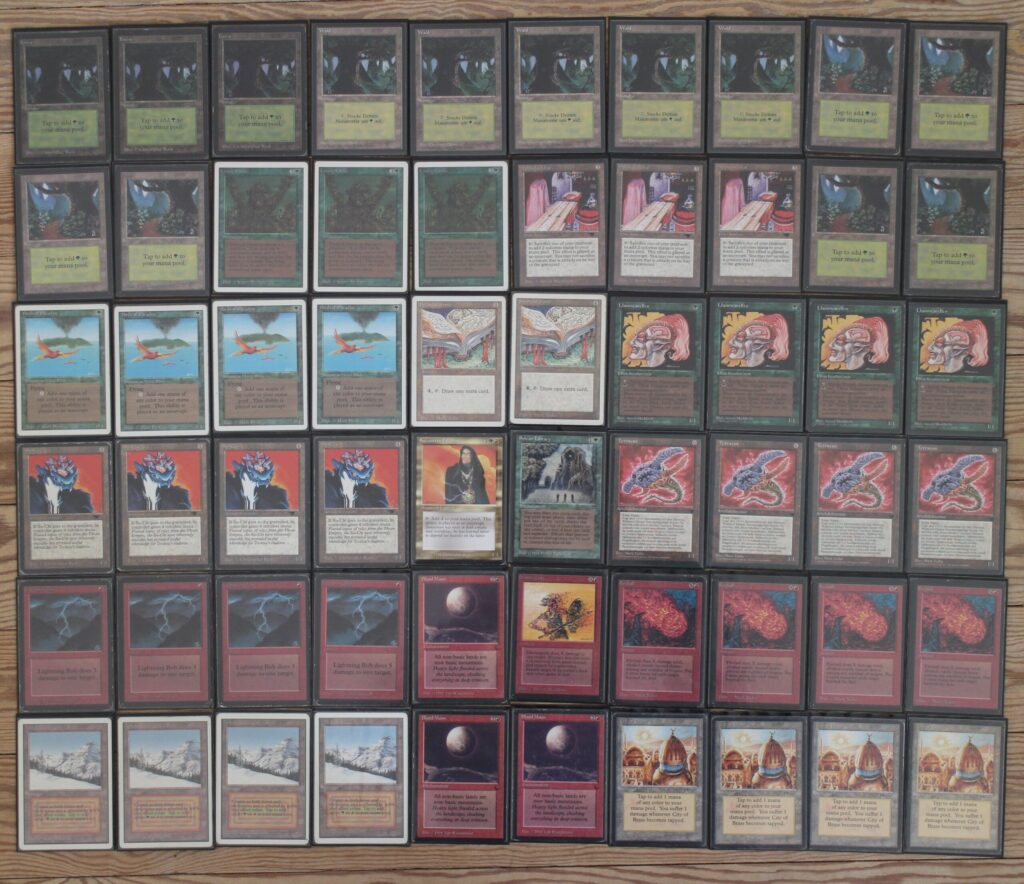
Why is this spicy? Well, I guess most people would consider it quite unconventional to play no restricted cards whatsoever. That is one. The other is that the entire game plan of this deck is unconventional or even somewhat flavored: You aim to play a bunch of dorks and other creatures – and even turn your Forests into critters too. Then you throw all of them on the Altar and shoot the opponent with a gigantic Fireball.
Spicy. Even slightly indecent, I’d say. I mean there is a Sunastian Falconeer in there!
But there is also a congruent, meaningful gameplan. The deck even plays some of its strengths in playing some Blood Moons. I don’t think many of us would not consider this deck a spicy entry in any tournament.
But what about this, then?
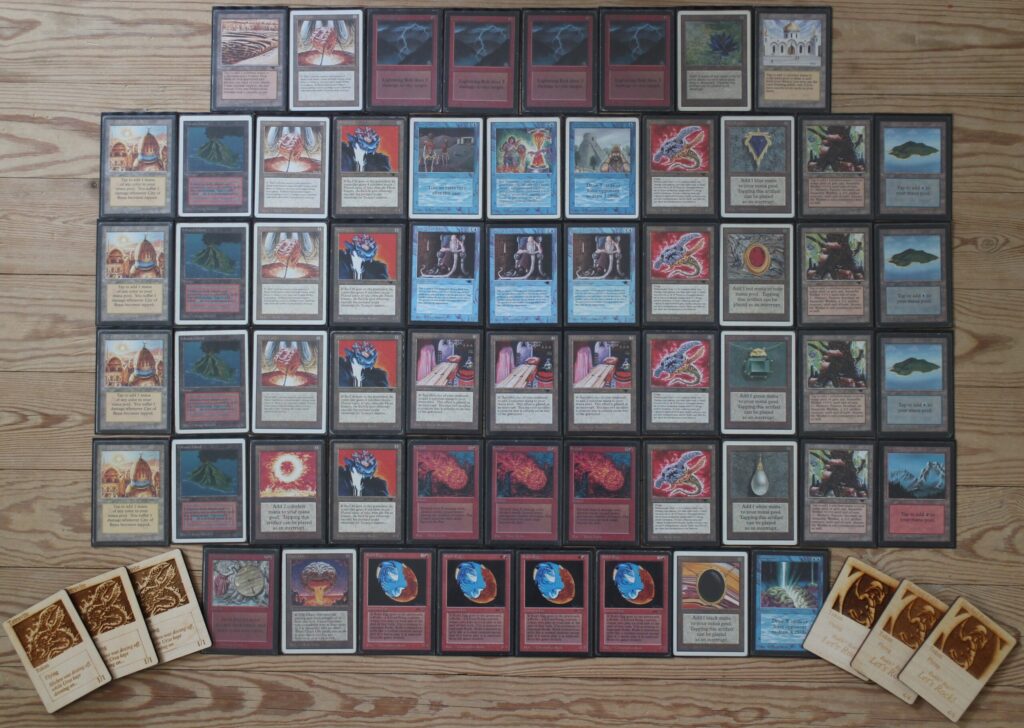
I’d say it is still more spicy than many of the decks you would meet in a tournament. But it really is basically a powered Robots deck, with a somewhat wacky plan of hurling big Fireballs off of altars. Same thing with my Ball Lightning-Animate Dead-Unsummon deck: Many of the cards are known and acknowledged powerhouses, the plan is somewhat streamlined and tested but then there are all these RRR 6/1’s. And Unsummon…
Spicy?
Yes? No? Maybe? Why?
If you were to attend a high-stakes spiky tournament with either of these decks, you would probably be hard pressed to reach the top8, and it would probably spark quite a lot of debate on card choices and whether or not this was actually the new thing. Your strategy would certainly be considered unconventional.
But if you brought the exact same pile to a round of kitchen-table after-hours shenanigans, some of your opponents might think of you as quite the uninvited Spike: “Playing power and stuff! A stringent plan? Uh howdy-wowdy.” In that setting, you would not be considered unconventional in the context. You would simply be considered as the guy who showed up with a deck full of power at a gathering of nice people who knew no better.
And as I mentioned earlier, I don’t think it is an easy task to get nearer to a firm definition than using the word unconventional.
In short, the point is, that being spicy is extremely context-dependent.
Context matters… until it don’t
But for how long? When does a deck or a strategy stop being spicy or unconventional?
How many cards should be swapped from the first list above, to remove the last bit of spicyness? And which ones should replace them? Obviously the deck could be changed into some stock R/G beats deck, and it probably wouldn’t be considered spicy anymore (at least not in most settings). But what if there were still just three Ashnod’s Altar? In my mind, it doesn’t make much sense to try and make a firm definition on these kinds of things. Especially because it would come down to numbers of cards differing from agreed upon stock lists. I remember at one time on one of the bigger Legacy format forums, where there was a lot of vivid discussion on what the stock list was for different kinds of deck types. Long, long posts defending that 60th card and why it was certainly stock. Let me just tell you, it was not fruitful in any way.
Because who can really, truly define what is the end-all stock list of anything in an ever-changing game like Magic; or when a deck really stops being spicy?
In short, it stops being spicy, when it stops being unconventional. And yes, as elaborated on above, that is very much a question of definition of the word unconventional. But at some point it just becomes clear that something is no longer “an odd choice” or in any way out of the ordinary. But it cannot be put on a form.
When more people pick it up and take it for a spin. When it becomes a reasonable choice in the nigh endless string of possibilities in the game. When you suddenly find yourself in a mirror of “spicy” decks. Then it is no longer truly spicy. For some decks and strategies, it is a very natural progression. Actually, in the history of Magic the Gathering, it is not too rare to see unconventional, spicy decks take over a format and become tier1 or similar. It is how many formats have evolved through the times. So also Old School, though to a lesser extent because it is a non-rotating format.
Conclusion
In conclusion, I think the most found, rather broad definition of spicy, is also the best one. You cannot narrowly define spicy, because it would be way too complicated and basically ruin the entire point of spicyness.
Spicy is more or less defined by not being definable. Which may also be the reason why I have had trouble finishing this article the last couple of months. Spicy is about exploring, about passion for the game and about a personal twist on the game. It is not about being best – it is about being something else, standing out.
Spice really is in the eye of the beholder – recently I was even nominated for a spice price playing this deck:
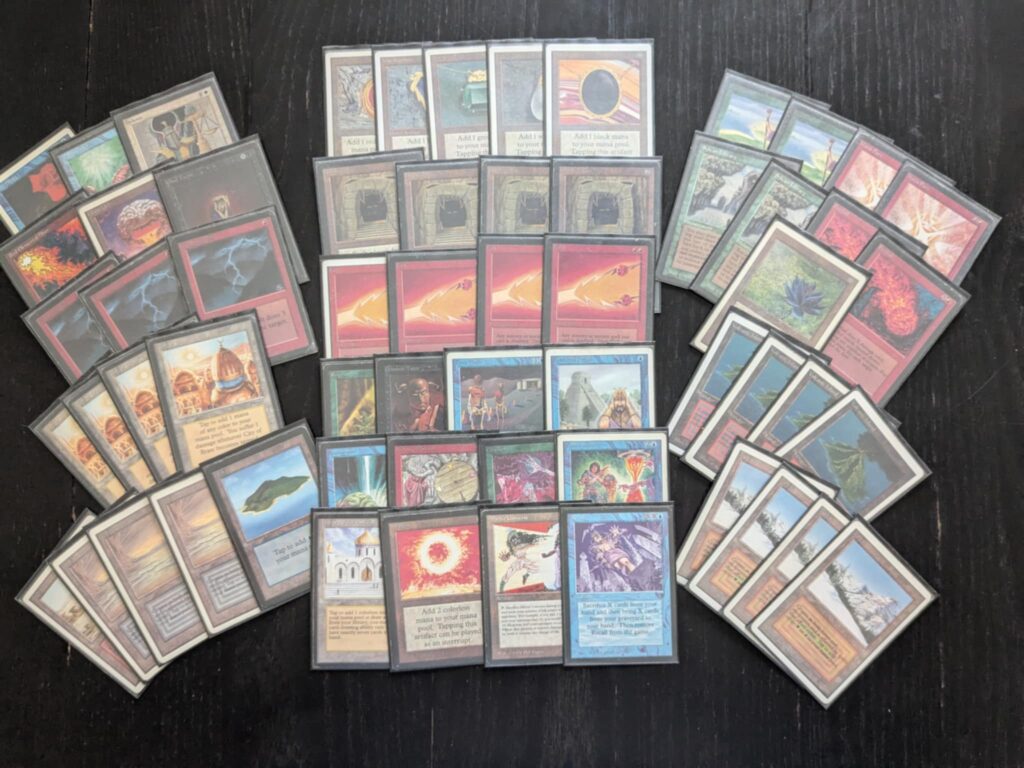
The reason: I played four Forks maindeck – not something you see often, but it is an established archetype that was one of the first really functioning combo decks. Spicy? Maybe? For what it’s worth, on the one hand, I would have never nominated myself in that situation, but on the other hand, I haven’t seen other players play Fork Recursion ever. In that view, it is unconventional. And it is certainly mildly indecent in every way.
Spice is in many ways what keeps Magic – and especially Old School – fresh and entertaining. If noone tried new things, I believe the format would dwindle. It may not die entirely – many players are driven by the winning part of the game – but I believe it would be a lot smaller, and lose a lot of its broad appeal.
4 Responses
Nice article! Fun topic to think about. Raises the question, “What brings the most fun for me?”.
Hot read! Thanks, Emil.
Once again, a great article from you, Emil.
I think you’re as spot on as can be — at least from my point of view, which doesn’t necessarily make it the correct one. As you said yourself, there are many different ways of looking at spice.
I do think the most challenging part of this topic is when spice and tournaments mix. I’ve heard people being sore losers at a spice tournament, saying things like, “But your deck isn’t as spicy as mine.” That’s such a strange thing to say. Some players seem to include just enough spice to qualify as spicy, while still packing enough spike cards to win — and that’s an approach I really dislike.
You know me, Emil — I’m spike to the bonemarrow. And back when I played EDH (many years ago), I ran into playgroups where one guy acted exactly like that. The conversation would go something like this:
Guy: “We don’t play Armageddon in this group.”
Me: “Fine, I’ll play Ravages of War then.”
Guy: “It does the same thing — you can’t play that either.”
Me: “How about Stasis or Blood Moon then?”
And the discussion would just go on and on, until he had ruled out basically every card that made him lose or exposed the weaknesses in his deck.
I’m not saying spice and spike players can’t coexist in a tournament setting — I have no problem with that, maybe because I’m firmly on the spike end myself 🙂
All I’m saying is that there’s a small percentage of spice players who seem to use spice as a way to shape the game/tournament/playgroup to their own advantage. And that raises the question: are they even spice players at all?
Cheers,
Martin
Keep up the good work!
I agree! Spice is such a very difficult thing to define precisely, and it doesn’t make much sense to try to do.
Especially in tournament settings. I think the only really good way (that I have come across anyway) is to let the tournament participants vote. Simple as that.
And also to always remember, that being spicy should be a personal choice that shouldn’t be too dependent on whatever anyone else does.